You might also wonder why most gamified projects eventually fade away. But let’s look at it from a perspective that’s often overlooked. The collapse of many GameFi projects between 2024 and 2025 can be traced back to poorly designed tokenomics. Mynaland has learned from these failures and presents a more structured and trustworthy model for investors.
GameFi Landscape in 2024 – 2025
• According to empirical reports, over 90% of GameFi projects in 2024 have seen drastic user declines or are inactive.
• Median lifespan of a new GameFi project is estimated at 4 – 6 months after launch.
• Many failures stem not from lack of ambition, but from structural mistakes in tokenomics overissuance, misaligned incentives, and weak utility And major investors!
Failed Projects & Their Tokenomics Mistakes
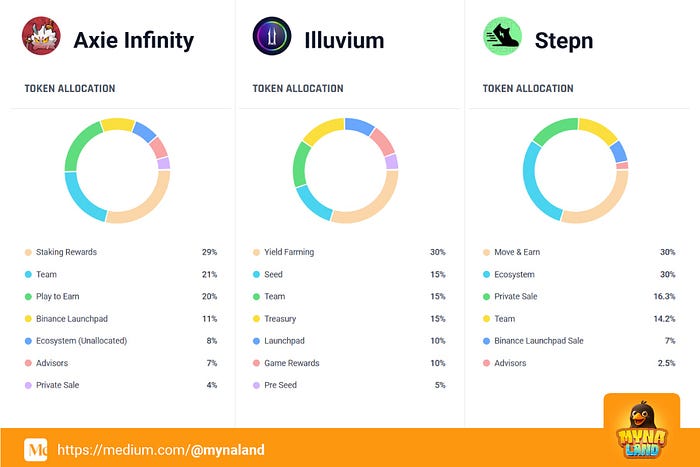
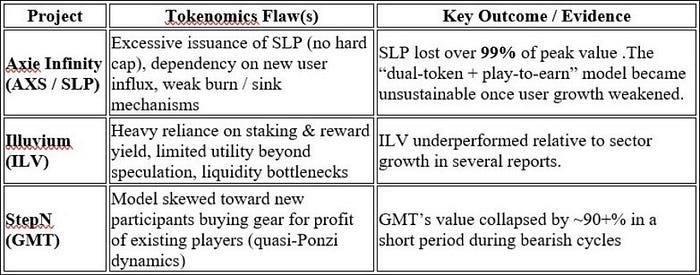
Below is a table summarizing several high-profile GameFi or hybrid blockchain game projects that ran into trouble specifically due to flawed tokenomics design.
Shared Tokenomics Failures (Diagnosis)
These are the recurring structural design mistakes found across failing GameFi projects:
• Uncontrolled inflation / excessive rewards: Tokens were minted as rewards faster than they could be burned or used.
• Growth-dependence (user acquisition at any cost): Many designs resembled a pyramid: new users’ capital subsidized early users.
• High barriers for typical users / overemphasis on whales: Large staking minimums or capital thresholds excluded many users.
• Tokens with limited or no utility: If the token is merely a reward with no strong use-case (governance, upgrade, access), retention fades.
• Premature token supply release: Projects distributed tokens before a stable ecosystem was built, leading to heavy early dumping.
These are also echoed in broader critiques of tokenomics failures in crypto.
How Tokenomics Should Be Built to Last
To avoid collapse, a GameFi tokenomics design should incorporate:
•Controlled issuance + burn / sink mechanisms
• Real utility for the token (access, upgrades, DAO, marketplace)
• Delayed token unlocks until ecosystem stability
• Inclusive participation thresholds to avoid whale dominance
• Transparent, upgradeable economic design
MynaLand Tokenomics, What Sets It Apart
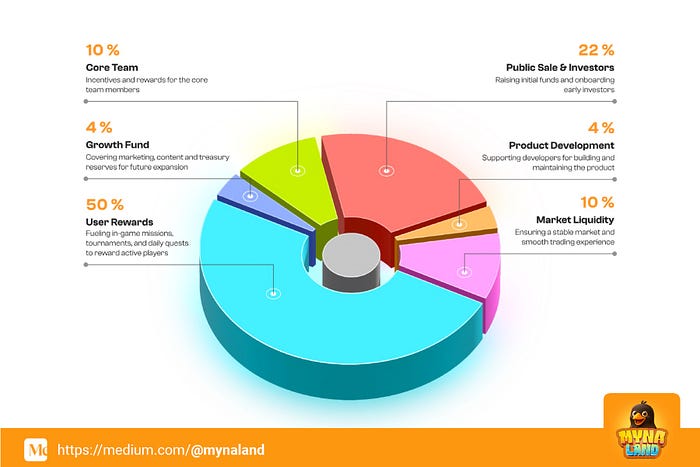
From myna.land (preliminary model):
• Blended Learn-to-Earn + Play-to-Earn: Users progress through learning modules before fully entering gameplay, which tempers early hyper-spend/earn cycles.
• Limited initial token release / phased distribution: Mitigates early dumping risk.
• Token & NFT integration: Token use is tied to NFT items, giving real utility and ownership.
• Adaptive model: As an early-stage project, the model can evolve based on empirical feedback, unlike rigid, overhyped predecessors.
• Emphasis on sustainable growth over hype: Focus on retention, gradual scaling, not explosive growth.
Conclusion & Call to Investors
Many GameFi projects collapsed not because their vision was flawed, but because their tokenomics lacked structural integrity. They were overreliant on hype, user inflows, and reward minting with little control.
MynaLand, with its hybrid model, measured token issuance, and token-NFT synergy, offers a more cautious and potentially sustainable path. For investors who prioritize longevity and structural soundness over short-term gain, MynaLand warrants a closer look.